Prototype 01
AM radio
Reception through concrete; static; audible transmission; effect of wall thickness; whether the mass behaves as a partial shield.
Exhibition proposal · 2026
An installation in response to Gaza and Palestine
Jonathan Vasata
Central proposition
We are creating the rubble
from which our own history
will be dug.
01 — Gaza / Palestine
This installation is made in response to the destruction of Gaza and to the Palestinian experience of destroyed civilian environments. It does not treat that destruction as a transferable metaphor for “conflict,” “memory,” or a general human condition. The architecture being buried is Palestinian domestic architecture. The ordinary objects being sealed are the ordinary objects of civilian life. The record being obstructed is a record of Gaza.
The work does not attempt to reproduce human suffering theatrically. It does not ask a gallery audience to perform identification with Palestinian experience. It concentrates on what can be made physically present in a room without impersonating the dead: architecture, domestic space, ordinary objects, interruption, burial, evidence, signal, historical record, responsibility, what remains.
The word our in Our History does not claim that an American gallery audience shares the Palestinian experience. It names the history being produced by everyone living through, witnessing, documenting, enabling, opposing, ignoring, or responding to this moment. The rubble belongs to Gaza. The history of how the world witnessed, enabled, opposed, documented, and responded to its creation belongs to this moment — and therefore to us.
Gaza will have its history.
So will those who watched it happen.
02 — The concrete
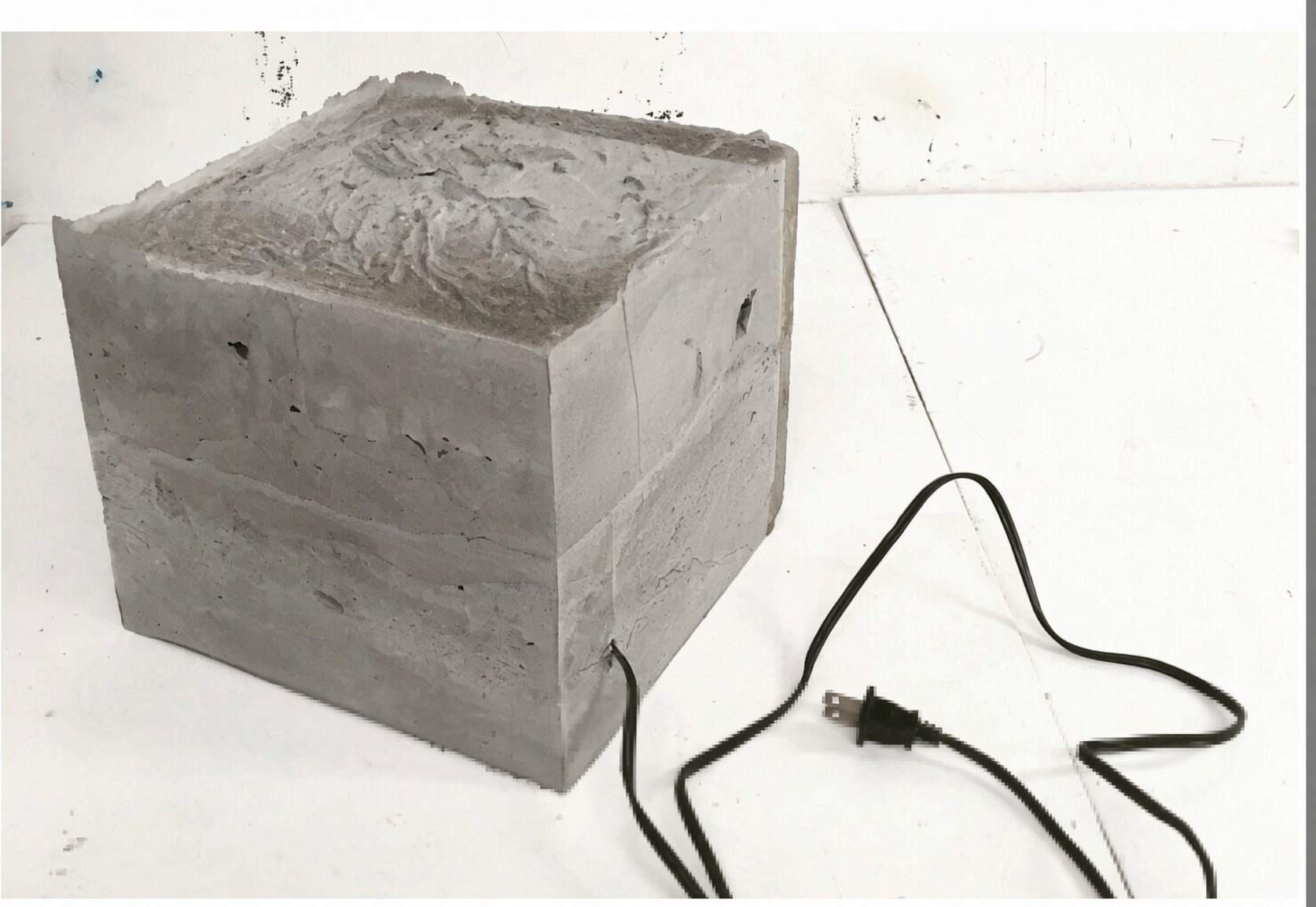
A physical prototype already exists. It is an approximately twelve-inch cube of poured concrete containing a functioning electrical object. The object is completely encased. It cannot be seen or retrieved. Only a cord emerges. When powered, the object continues to function inside the mass.
The concrete is to remain rough and imperfect. Pour lines, voids, broken arrises, and the visual character of construction material are retained. A pristine Minimalist cube would convert the work into an object of taste. This is poured matter, not a designed relic.
Ordinary life remains inside it, inaccessible.
03 — The room
Imagine a gray or neutral gallery. Across the floor, heavy concrete blocks. Black cords leave them and run to protected external power. Immediately above each block a twelve-inch black-and-white moving image documents destruction in Gaza. The block intrudes into the beam. A dark physical shadow occupies the bottom of each image.
The room is not silent. Something is happening inside the concrete: static, a muffled transmission, vibration, an alarm, a mechanical hum, perhaps fragments of speech. The objects cannot be seen. They cannot be recovered without destroying the concrete. Evidence of their continued existence escapes.
A solid twelve-inch cube of normal-weight concrete weighs on the order of 145–150 pounds. The audience does not move the blocks. Positions are set by the artist after testing and remain fixed. That immobility is architectural, not theatrical.
The proposed first exhibition scale is five to eight blocks, not a warehouse field. Scale should follow what the prototypes can actually do, what the floor can carry, and what the projection geometry can hold. More blocks can be added only after the first group is true.
The viewer enters a gray room and finds architecture on the floor and documents in the air. The first reading may be sculptural. The second is auditory. The third is the discovery that the bottom of each image is missing because the object in the room has taken it. Nothing is interactive in the consumer sense. There is no reconstruction kit, no QR code that “explains Gaza,” no headset. The work asks for the slower attention that a ruin already demands: standing near mass, noticing a signal, noticing what cannot be opened.
04 — The objects
The blocks are not figurative representations of Palestinian bodies. They contain ordinary functioning objects buried within architectural mass: a radio, an alarm, a speaker, a motor — mundane technologies associated with civilian life.
In the context of Gaza, sound, vibration, or signal emerging from beneath rubble inevitably carries another association: listening for evidence of life beneath collapsed buildings. The work accepts that association without turning the blocks into bodies or simulating trapped people. It does not use recorded cries, breathing, knocking, heartbeats, or other theatrical human cues. Ordinary machines remain ordinary machines. Their muffled operation produces the ambiguity.
05 — The buried objects
Each block contains a different functioning electrical object associated with ordinary domestic life. Candidate devices include an AM radio, a vibrating motor, a buzzer or alarm, and a speaker fed from an external audio source — or other low-voltage devices whose activity can actually be detected through concrete.
A buried lamp that only generates heat is not enough. A silent quartz clock is not enough. The viewer must be able to detect evidence that something inaccessible remains active inside the block. That evidence may be sound, static, radio reception, vibration, mechanical movement, electromagnetic interference, or audio transmission. This is a rule of inclusion, not a metaphor. Devices that fail it are rejected.
The ruins contain what they destroyed.
06 — Image / Shadow
Immediately above each concrete block is a small projected black-and-white moving image, approximately twelve inches square — corresponding to the face of the block beneath it. The moving images are documentary footage of the destruction of Gaza. They emphasize destroyed architecture, collapsed buildings, streets, rubble, excavation, damaged domestic interiors, dust, people navigating destroyed environments, and the physical aftermath of destruction.
The projections are not cinema. They should read as records, documents, evidence, fragments: small moving archival windows. Graphic imagery of the dead or injured is not the visual argument. The architecture and the aftermath are.
The projector is positioned so that the actual concrete block interrupts part of the beam. The upper edge of the block casts a real shadow into the bottom of the projected image. The shadow is not digital. The sculpture obstructs the document.
Fig. 02 Geometry test. A twelve-inch field interrupted by a twelve-inch mass. The lower band is a physical shadow, not an edit. No documentary footage is shown here. Licensed images are not implied by this study.
Each block may carry its own independent loop. The room becomes a field of small moving records rather than a single screening. Sound from the footage should not dominate. The primary soundscape belongs to the buried objects. The default for the videos is silence.
The projection and the concrete occupy approximately the same visual dimensions. The image is visible and intangible. The buried object is tangible and invisible.
What has been buried
has not necessarily been silenced.
07 — Archaeology
The blocks resemble remains that have already been sealed, while the historical event that produced them is still unfolding. The concrete appears historical. The electrical object remains active in the present. That temporal contradiction is the work’s clock.
The question is not whether history will eventually look at Gaza. It is what will be excavated from the history being made now — including the history of those who watched.
An earlier investigation, Objectophilia (Animals), 2018, treated the meaning of objects as contingent on their position and their relationships inside gallery space. Things did not stay the same when they were moved. Our History can extend that investigation from interpretation into physical behavior if tests demonstrate repeatable effects. Until that evidence exists, placement is determined experimentally by the artist during installation. The audience does not rearrange the blocks.
08 — Time / failure
Once cast, the embedded objects cannot realistically be repaired. That limit is part of the work. If a device fails during the exhibition, the block is not opened, not recast, and not replaced with a noisier substitute. Failure is not engineered in advance. Silence, if it arrives, is evidence of duration. A room that begins with several signals may end with fewer. That is the work keeping time.
09 — Statement
Jonathan Vasata is an artist working with objects, installation, and the conditions under which inanimate things appear to act. Our History is built from concrete, low-voltage electrical objects, and small black-and-white documentary projections. It is not a memorial in the conventional sense and it does not end in consolation.
The final turn of the work is toward the people standing in the gallery. They are not looking at an archaeological record that someone else completed. They are standing inside the historical moment that will produce one.
Technical + rights notes
The notes that follow are for fabrication, venues, and rights. They do not need to be read in order to encounter the work.
Note — Electrical
Ordinary 120-volt thrift-store appliances will not be buried in concrete. Heat, retained moisture, the alkalinity of cement, insulation failure, the impossibility of inspection, fire risk, and gallery liability make that architecture unacceptable. The visual gesture that must be preserved is simpler: a cord leaves the concrete, and something inaccessible inside remains alive.
External mains → protected AC-to-DC conversion outside the block → fusing and appropriate electrical protection → low-voltage wiring entering through a sleeved channel → low-voltage device inside the concrete.
The device is potted or otherwise isolated from wet cement during the pour. Wiring is specified for alkaline and moisture exposure. Power supplies remain inspectable. Circuits are GFCI-protected. Components are listed where listing exists. Heat is measured in prototype, not guessed. If a device cannot run continuously without a dangerous temperature rise, it is not cast.
Floor load is part of the design. Each block is a concentrated point load of roughly 150 pounds before a viewer stands beside it. The host venue confirms live-load capacity. If the floor requires it, blocks sit on a distribution plate that does not become a pedestal.
Note — Prototype testing
One prototype exists. The full installation is not fabricated from that single object. Approximately four experimental blocks are required first. Only interactions that can be demonstrated enter the work as shown.
Prototype 01
Reception through concrete; static; audible transmission; effect of wall thickness; whether the mass behaves as a partial shield.
Prototype 02
Surface vibration; transmission into the floor; audibility at standing distance; heat over continuous run.
Prototype 03
Audibility; frequency attenuation; whether the signal remains intelligible or becomes only a pressure in the room.
Prototype 04
Audio through mass; measured interference; proximity effects; whether two blocks can alter one another at documented distances.
Each study is documented with photography, video, audio, distance measurements, device specifications, concrete thickness, operating duration, and failure behavior. AM reception through a twelve-inch pour is not assumed. Electromagnetic interaction is not assumed. If Prototype 01 is mute, the radio is not included.
Note — Footage
Documentary footage of Gaza is not a free material. News agencies, freelance journalists, and civilians hold copyright in almost every widely circulated clip. Fair use is not a plan. An exhibition that projects other people’s records of destruction without clearance can injure the work, the venue, and the people who made the images under fire.
No clip enters the installation until its rights are secured — by license, by commission, by the artist’s own recording, or by another written grant that a gallery’s counsel can read. Preference is given to material that documents architecture and aftermath rather than the wounded body.
Provenance of every loop is logged: source, date if known, rights status, duration, whether the image has been cropped or slowed, and why that fragment was chosen. Where footage is used, the image-maker is credited visibly in the exhibition.
Note — Projection geometry
A one-foot square moving image immediately above a one-foot cube cannot be improvised with a conference-room projector across the gallery. Either a short-throw or pico projector is dedicated to each block and aimed at a prepared vertical plane — wall, panel, or baffle — or the shadow relationship loses its precision.
The physical shadow requires front projection. The block must stand in the beam. Throw distance, height, and the top edge of the cube are surveyed together. Ambient light is controlled. Projector noise is treated as contamination of the buried soundscape and must be quieter than the objects, or the objects lose the room.
Independent loops mean independent sources. Synchronization is not required and should not be faked with a show-control system that turns the field into a single media work. If a projector fails, its block remains. The concrete does not depend on the image in order to exist.
Note — Open limits
An American artist making an installation in response to Gaza and Palestine occupies a position that is not innocent. The work does not speak as Palestinian, does not offer the gallery a conscience-cleansing encounter, and does not convert destruction into a portable allegory. Its claim is narrower: that this destruction is occurring inside the historical present of the people who will look at the work, and that they are already inside the record they are viewing.
Concrete attenuates sound and can shield radio. The inclusion rule may eliminate devices the concept currently lists. That is acceptable. The list is a research agenda, not a packing list.
A cord means the object is not a closed archaeological secret. The sleeved entry is a necessary compromise. It should remain visually modest and should not be stylized into a precious detail.
Multiple projectors, heat, fan noise, and a physical shadow at this scale are a real installation problem. If the shadow cannot be produced cleanly, the projection component should be postponed rather than simulated in software.